
Dental Implant Crown Workflow: Complete Digital Process
For dental practices placing implants, the crown workflow is where fit, function, and patient satisfaction are ultimately decided. A digital implant crown workflow removes many of the variables that used to come with traditional impressions, giving both clinicians and labs tighter margins, better occlusion, and fewer remakes.
This guide breaks down how a modern digital implant restoration process works from start to finish, and why it produces more predictable results than analog methods.
Why the Implant Crown Workflow Matters
An implant crown isn’t just a cosmetic restoration, it has to integrate precisely with the abutment, sit correctly within the bite, and hold up under daily function for years. Even small inaccuracies in the impression or model stage can lead to poor margins, occlusal high spots, or a crown that doesn’t seat properly, all of which mean chair time spent on adjustments or, worse, a remake.
This is exactly where a digital implant crown workflow makes the biggest difference. By capturing data digitally at each stage and carrying it through design and fabrication without physical models introducing error, labs can produce a custom dental implant crown that fits accurately the first time.
Step-by-Step: The Digital Implant Crown Workflow
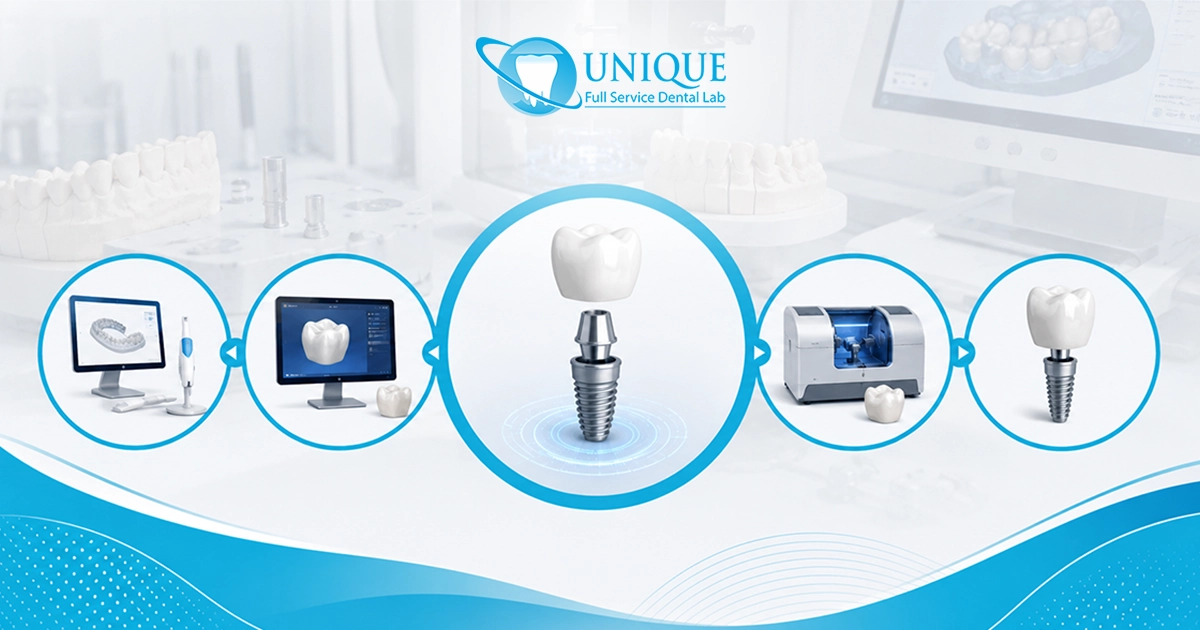
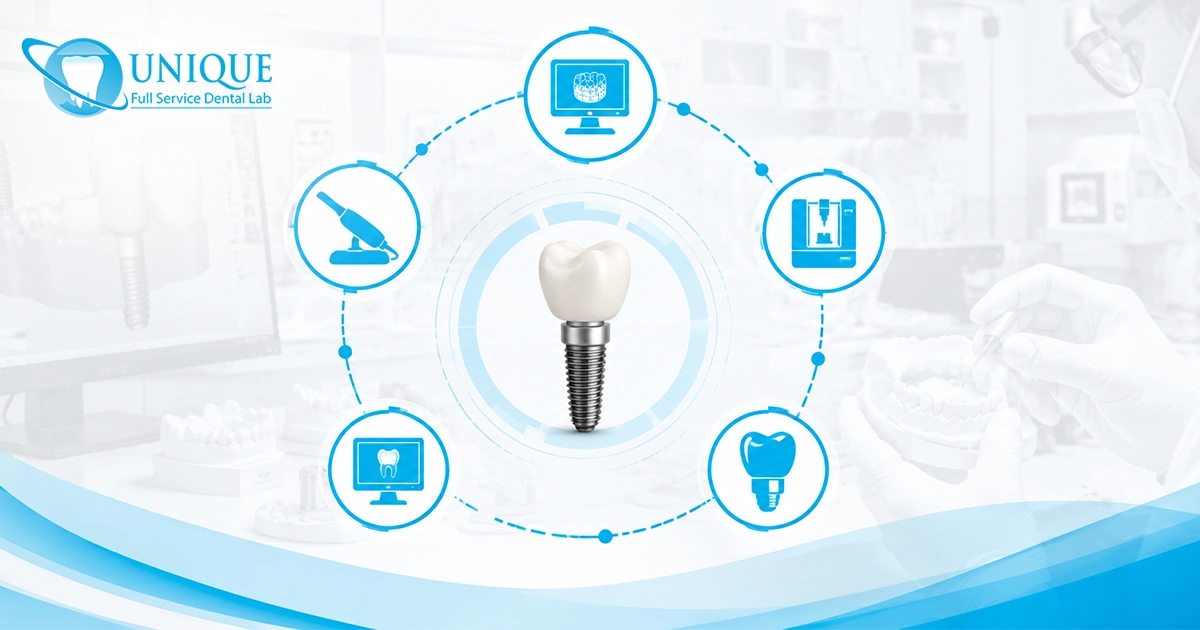
- Intraoral scanning. Instead of a traditional impression tray, the clinician captures a digital scan of the implant site, the surrounding dentition, and the opposing arch. This scan captures the exact position of the implant using a scan body, which tells the lab precisely where the abutment connection sits in three-dimensional space.
- Digital case transfer. The scan file is sent directly to the lab electronically, often within minutes of the appointment. This eliminates the delays, distortion, and shipping damage that come with physical impressions or stone models.
- Virtual model and design. Using CAD software, the lab technician builds a virtual model of the arch and designs the crown directly on screen. At this stage, the technician can evaluate margins, contact points, and occlusion against the opposing arch with a level of precision that’s difficult to achieve by hand.
- Abutment and crown design integration. For implant cases, the crown design has to account for the abutment connection type, emergence profile, and screw access channel if it’s a screw retained restoration. Digital design tools let the technician fine tune these details before anything is milled or printed.
- Milling or 3D printing. Once the design is finalized, the restoration is either milled from a solid block of zirconia or ceramic, or fabricated using 3D printing technology, depending on the material and case requirements. CAD/CAM milling in particular allows for same day turnaround on many cases.
- Finishing and quality check. After fabrication, the crown is finished, glazed or stained to match shade, and checked against the digital model to confirm margins and contacts are accurate before it’s shipped back to the practice.
- Try-in and delivery. Because the digital process captures such precise data upfront, the final seating appointment typically requires far less adjustment than with a traditionally fabricated crown.
Benefits of a Digital Implant Restoration Process
Improved accuracy. Digital scanning removes the distortion risk that comes with physical impression material, and virtual models don’t shift or degrade the way stone models can.
Faster turnaround. Digital case files move between the practice and the lab instantly, and CAD/CAM milling can often produce a crown in a fraction of the time traditional fabrication requires.
Fewer remakes. Because margins, contacts, and occlusion are all verified digitally before fabrication, clinicians see fewer fit issues at delivery.
Better communication between practice and lab. Digital files let the lab flag potential issues, like inadequate scan body capture or unclear margins, before the crown is ever fabricated, rather than after a physical model has already been poured.
Consistency across complex cases. For multi-unit implant cases or full arch restorations, digital workflows make it far easier to keep occlusion and alignment consistent across every unit.
What to Look for in a Digital Dental Lab Partner
Not every lab offering “digital” services provides the same level of precision. When evaluating an implant crown workflow partner, practices should look for:
- Experience with a range of implant systems and scan body protocols
- In-house CAD/CAM milling and 3D printing capability rather than outsourced fabrication
- A track record of accurate margins and reliable turnaround times
- Clear communication if a scan needs to be retaken or a design detail clarified
Why Practices Trust Unique Dental Lab for Implant Crown Cases
At Unique Dental Lab in Richardson, Texas, our team brings a combined 75 years of experience to every custom dental implant crown we fabricate. We work with intraoral scan files, in-house CAD/CAM milling, and 3D printing technology to move cases from digital design to finished restoration efficiently, without sacrificing the accuracy your patients depend on.
Whether you’re sending your first digital case or looking for a more reliable digital implant crown workflow partner, our team is equipped to handle single unit implant crowns and complex multi-unit cases alike.
Ready to Streamline Your Implant Crown Cases?
If your practice is ready to move to a more accurate, efficient digital implant restoration process, contact Unique Dental Lab today to discuss your case requirements or submit your next digital scan through our order form.

Leave a Reply