
Porcelain Fused to Metal Crown Explained: Are They the Right Choice for You?
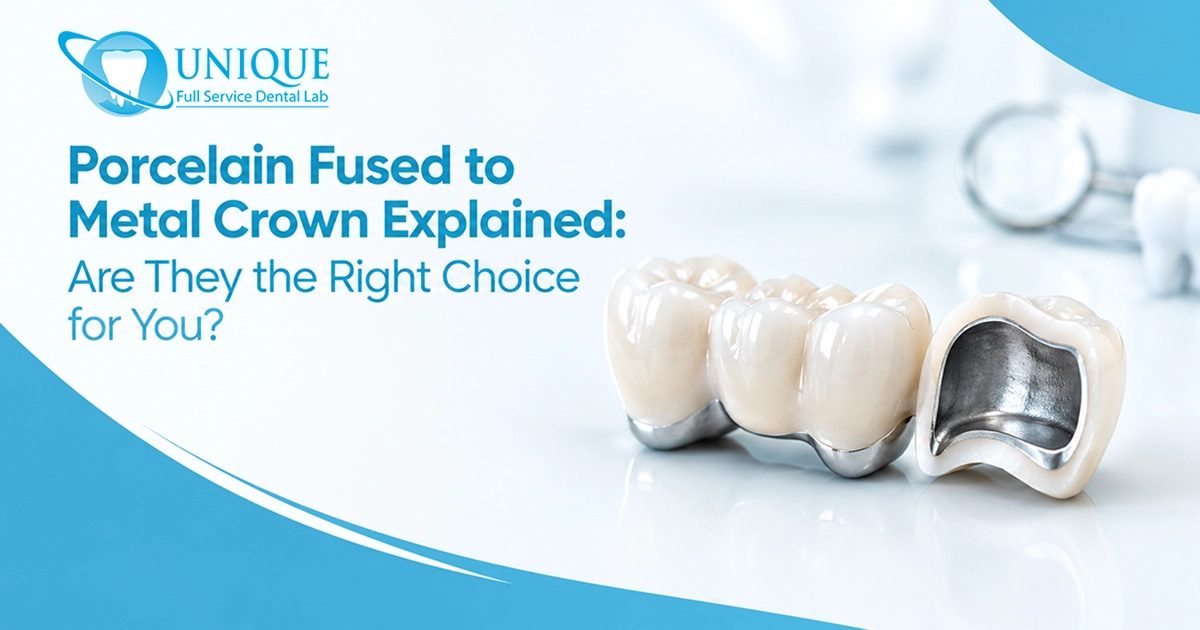
Porcelain Fused to Metal Crowns Explained: Are PFM Crowns Right for Your Case?
Monolithic zirconia now gets most of the attention in restorative dentistry, but a porcelain fused to metal crown is still a legitimate, well-documented choice. For the right case, it can be the more predictable one.
The short answer: PFM crowns are a strong option when you need strength, a reliable marginal fit, or a proven record in demanding situations. They are a weaker option when the priority is lifelike translucency in the anterior zone, or when a patient has a confirmed sensitivity to the alloy. The rest of this article explains how to tell which situation you are in.
What is a porcelain fused to metal crown?
A porcelain fused to metal crown has a cast or milled metal substructure, with dental porcelain fired onto it in layers. The metal provides strength and marginal integrity. The porcelain provides tooth-like color and surface. You may also see it called a PFM dental crown, a metal-ceramic crown, or a porcelain metal crown.
Because the metal is opaque, the ceramic layers must mask it. That is the root of both the main strengths and the main limits of the restoration.
PFM crown material: the alloy matters
“PFM crown material” really means two materials, the alloy and the ceramic, and the alloy is where most of the decision-making sits. Laboratories generally work with non-precious, semi-precious, or high-noble alloys, and our porcelain fused to metal service page describes all three categories for current metal-ceramic work. Alloy choice affects cost, the way the oxide layer bonds with porcelain, and how the restoration behaves in the mouth. If a patient has a known metal sensitivity, it also affects biocompatibility.
What does the clinical evidence say?
Two systematic reviews from the same research group are worth knowing.
For tooth-supported single crowns, a 2015 review pooled data from 67 studies. It estimated a 5-year survival rate of 94.7% for metal-ceramic crowns. The same review found that densely sintered zirconia crowns were lost to veneering-ceramic fractures more often than metal-ceramic crowns, and that all-ceramic crowns showed higher 5-year rates of framework fracture overall. Its overall conclusion was balanced: most types of all-ceramic crowns performed similarly to metal-ceramic crowns, in both anterior and posterior regions.
For implant-supported single crowns, a 2018 review reported an estimated 5-year survival of 98.3% for metal-ceramic crowns versus 97.6% for zirconia crowns. Veneering-ceramic chipping rates were nearly identical (2.9% versus 2.8%), but significantly more zirconia crowns failed from material fracture (2.1% versus 0.2%). The authors also noted that no studies on newer monolithic zirconia crowns met the review’s follow-up criteria.
How to read this:
- PFM has a long, large evidence base. Newer materials are catching up, but “equivalent” is not the same as “proven better.”
- Chipping is not unique to PFM. Veneered zirconia chips at a similar rate, and it fractured more often in these reviews.
- The reviews mostly cover veneered zirconia. They do not settle how modern monolithic zirconia compares, so be cautious about citing them either way for that comparison.
When do PFM crowns make sense?
PFM tends to be a good fit when:
- The occlusal load is high. Posterior teeth in patients with heavy function or parafunction benefit from a metal framework.
- Margin integrity is a priority. Metal can be finished to a precise, stable margin.
- The span is long or the case is complex. PFM has a long track record in bridges and multi-unit restorations.
- Cost control matters. Depending on the alloy, PFM can be a more economical option than some all-ceramic systems. Precious-metal pricing moves, so confirm current costs with your lab.
- Esthetic demands are moderate. Premolars and molars outside the smile line are the classic indication.
Where PFM falls short
- Esthetics. Even well-layered PFM can lose some of the depth and translucency of a natural tooth, because the opaque layer blocks light.
- A visible metal margin. If gingival recession occurs, a dark line can show at the cervical area. Margin design and patient risk factors matter here.
- Veneer chipping. The porcelain can chip, especially under heavy or poorly distributed occlusal forces. Careful occlusal design reduces the risk. It does not remove it.
- Alloy sensitivity. True metal allergy is uncommon but real. Check the patient history before you choose an alloy.
- Tooth reduction. PFM needs enough room for both metal and porcelain, so it can call for more reduction than some monolithic options.
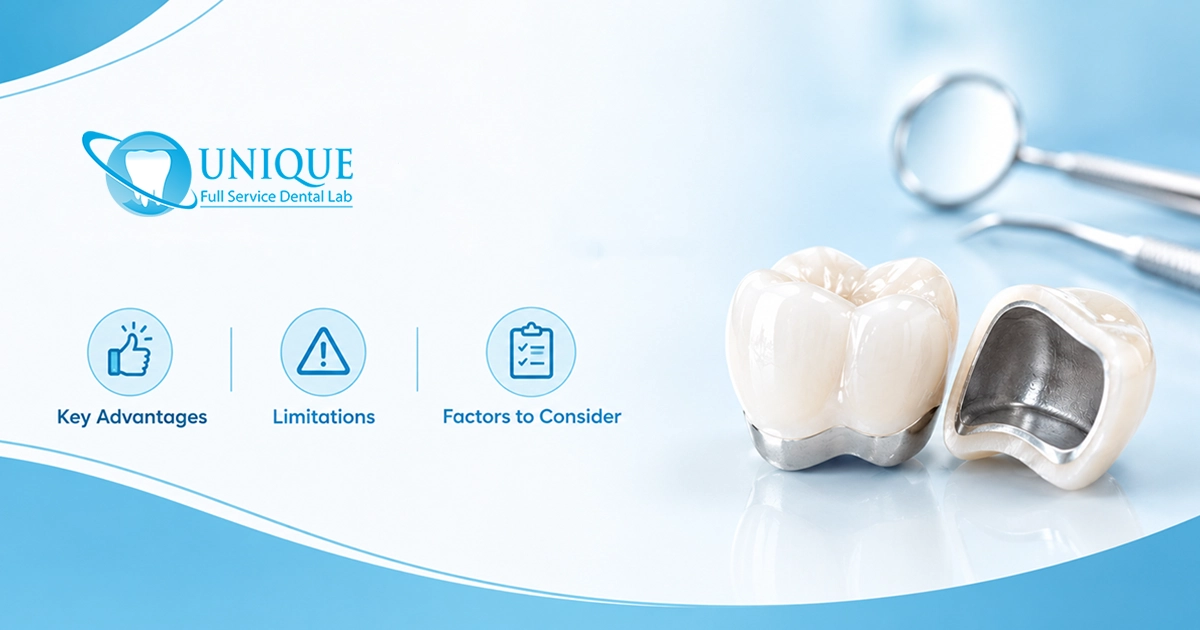
PFM vs. zirconia vs. layered all-ceramic
| Factor | PFM | Monolithic Zirconia | Layered / Veneered All-Ceramic |
|---|---|---|---|
| Anterior esthetics | Moderate | Moderate, depending on shading | Highest potential |
| Posterior strength | High | High | Varies by system |
| Veneer chipping risk | Present | Minimal (no veneer layer) | Present |
| Metal-related concerns | Yes | No | No |
| Track record | Longest | Shorter | Varies |
| Typical role | Posterior and complex cases | Posterior, full-contour cases | Anterior cases |
This table is a general guide, not a rule. Individual systems, alloys, and clinical conditions change the picture.
A quick case-selection checklist
Ask these before prescribing:
- Is the tooth in the smile zone, and how high are the patient’s esthetic expectations?
- How heavy is the occlusion, and are there signs of bruxism?
- Is there enough interocclusal space for metal plus porcelain?
- Does the patient have a history of metal sensitivity?
- Is gingival recession likely to expose the margin over time?
- What is the budget, and which alloy tier fits it?
If the answers lean toward strength, margin precision, and budget, PFM deserves serious consideration. If they lean toward esthetics and metal-free treatment, look at the options on the all-porcelain restorations page.
What to put on the prescription
A good PFM result starts with a clear Rx. Specify:
- Your alloy preference (or ask the lab to recommend one for the case).
- The shade, plus the prepared tooth shade where it affects opacity.
- Margin design, including whether a porcelain margin is wanted.
- Occlusal scheme and any parafunction concerns.
- Any known metal sensitivity.
A short call with the lab before a complex case often saves a remake.
Porcelain fused to metal crown FAQs
Are PFM crowns still a good choice compared with zirconia?
Yes, for the right case. In a pooled review of tooth-supported single crowns, most all-ceramic crown types performed similarly to metal-ceramic crowns, in both anterior and posterior regions. “Similar” is not “better,” so the decision should follow the occlusal load, esthetic demands, and patient history rather than the material’s reputation.
How long do PFM crowns last?
No review can promise a lifespan for an individual crown. The best available figure is a 5-year survival estimate: 94.7% for metal-ceramic tooth-supported single crowns. Longevity in practice depends on occlusion, preparation design, oral hygiene, and parafunction.
Do PFM crowns chip more often than zirconia?
Not according to the reviews cited above. For implant-supported crowns, veneering-ceramic chipping was nearly identical (2.9% for metal-ceramic and 2.8% for zirconia-ceramic). In the tooth-supported review, densely sintered zirconia crowns were lost to veneering-ceramic fractures more often than metal-ceramic crowns. These findings mostly concern veneered zirconia, not monolithic zirconia.
Can PFM crowns be used on implants?
Yes. One review estimated a 5-year survival of 98.3% for implant-supported metal-ceramic crowns. Screw-retained versus cement-retained design, abutment choice, and occlusal scheme still need to be planned for each case.
Which alloy should I specify for a PFM crown?
It depends on the case. Laboratories generally work with non-precious, semi-precious, and high-noble alloys, and each affects cost, porcelain bonding, and biocompatibility. If you are unsure, ask your lab to recommend an alloy for the specific restoration. A short conversation before a complex case can prevent a remake.
Will the metal margin show?
It can. If the gingiva recedes, a dark line may become visible at the cervical area. Margin design, including whether a porcelain margin is appropriate, and the patient’s recession risk should factor into your choice. If the margin is in the esthetic zone, consider the all-ceramic options on our all-porcelain restorations page.
What if my patient has a metal allergy?
True metal allergy is uncommon but real. Review the patient’s history before you choose an alloy. If there is a confirmed sensitivity, a metal-free restoration is usually the safer route. Confirm the details with the patient’s physician or allergist where needed.
How do I order a PFM crown from Unique Dental Lab?
Submit your case through the RX order form. If you want pricing first, use the quote form on our porcelain fused to metal service page, or contact our team with questions about a specific case.
Conclusion
PFM crowns are not a legacy material that has been replaced. They are one tool with a strong evidence base and a clear set of strengths, and the choice should follow the case, not the trend. When strength, margin integrity, and cost lead, PFM is often right. When translucency and a metal-free restoration lead, consider the alternatives.
If you want a second opinion on a specific case, or a quote on a PFM restoration, contact Unique Dental Lab or submit your case through the RX order form.

Leave a Reply